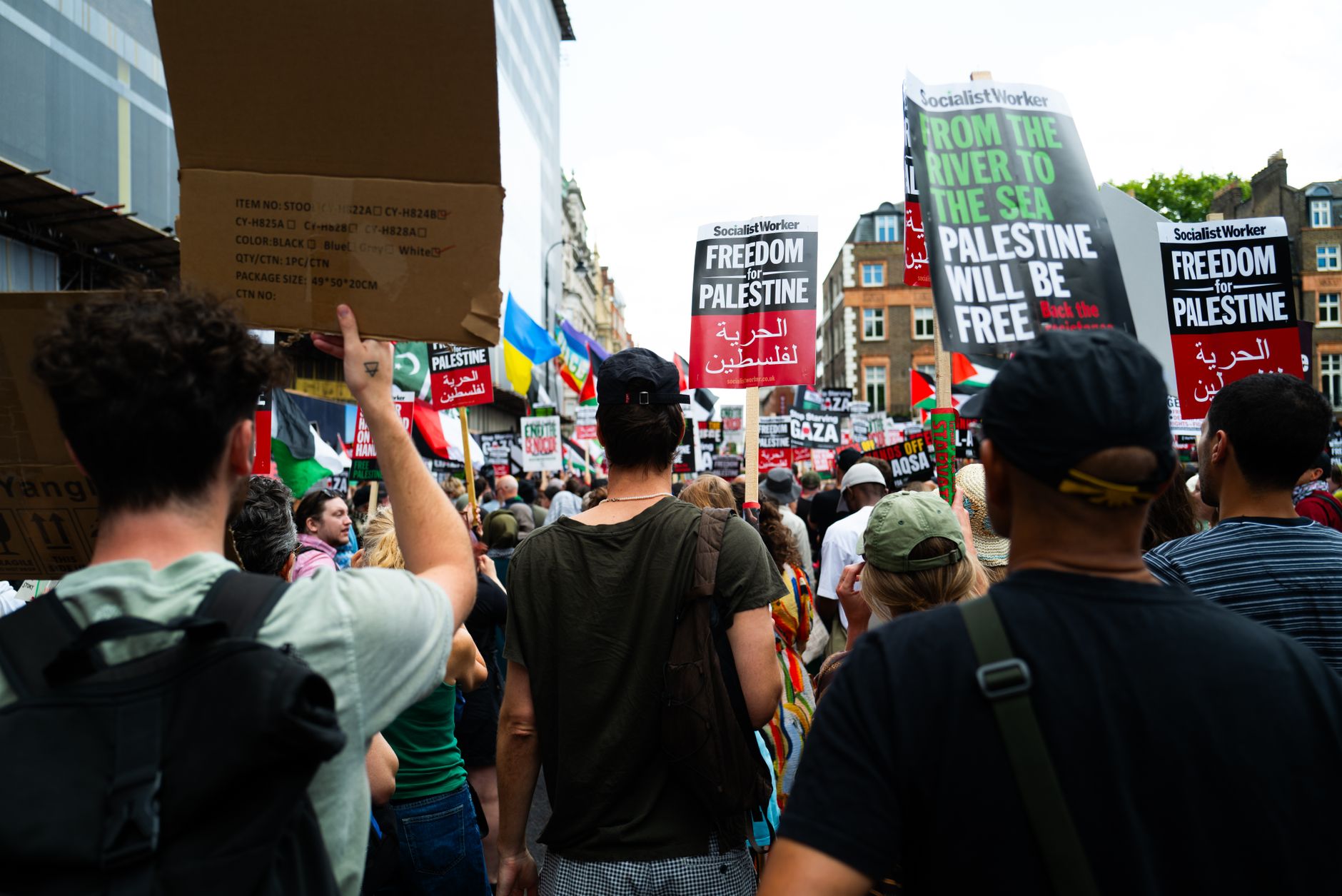
2,000 Marchers, 700 Police, and a Berlin Protest Most English Feeds Skipped
Berlin's Nakba Day march drew about 2,000 people and 700 police, dominated German domestic coverage, and barely surfaced in mainstream English-language news beyond a handful of clips and agency images.
Around 2,000 people marched through Berlin-Kreuzberg on Friday to mark the Palestinian Nakba, and rbb24 reported that 700 police officers shadowed the route from Oranienplatz to Südstern. German outlets covered it as a major domestic order story. In mainstream English-language news, it barely landed. That matters for anyone trying to understand how the Gaza war is still reshaping European streets and speech.
By early evening, Berlin police had made 15 arrests, according to rbb24 and Die Zeit. The gap fits a pattern Albis has tracked before in how English coverage drifts on Israel-Palestine over time, in how protest scenes become proxy battlegrounds far from the front line, and even in Berlin's undercovered Sudan donor conference. Stories can dominate one language sphere and barely exist in another.
The basic facts were not hard to find if you were reading German outlets. rbb24 said about 2,000 people joined the march in Kreuzberg. It said 15 participants were arrested and one police officer was injured but remained on duty. Die Zeit, citing police, also reported 15 arrests. The demonstration commemorated what Palestinians call the Nakba, the mass displacement tied to Israel's founding in 1948.
The story becomes more interesting when you compare what different news systems chose to emphasize. German local coverage treated the march mainly as a security and public-order event. Reports in rbb24, Tagesschau and other domestic outlets focused on the size of the deployment, the arrests, the route, prior unrest at Nakba demonstrations and allegations of assaults on officers or banned symbols. That is a recognisable German press frame: the key question is whether Berlin can manage a politically explosive protest without disorder.
Coverage linked to Middle East audiences stressed something else. Al Jazeera's video item said footage showed police "violently hitting and pepper-spraying protesters" as thousands gathered for the 78th anniversary. In that frame, the event is less about crowd management than about the policing of Palestinian solidarity in Europe. The same march becomes evidence in a wider argument over civil liberties, selective tolerance and the export of the Gaza conflict into European domestic life.
What was missing was broad English-language pickup outside those already following the issue closely. A search of English results produced an Al Jazeera clip, agency imagery and scattered secondary items. It did not produce the kind of sustained reporting that would normally accompany a heavily policed protest in a European capital linked to one of the world's most sensitive conflicts.
That absence is the real story. Berlin is not a peripheral city in the global news map. Germany is one of Europe's central diplomatic actors on Israel and Gaza. Its domestic handling of pro-Palestinian protest matters because it signals how far major Western democracies are prepared to push public-order logic into the territory of speech, assembly and historical memory.
That creates a distorted picture for English-language audiences. Since the Gaza war intensified, European capitals have become secondary theatres where foreign policy, migration politics, antisemitism fears, Islamophobia concerns and free-speech arguments collide in the same square. English readers usually see the diplomatic headlines and the worst violence, but miss the intermediate scenes where the political temperature is actually measured: who gets to march, how police intervene, what chants become the focus, and which side of the encounter each media system puts in the first paragraph.
Friday's march was one of those scenes. In German coverage, it was a tense demonstration with arrests and a large police presence. In Middle East coverage, it was a case study in rough policing at a Palestinian commemoration. In the broader English-language feed, it was close to invisible.
That is why this belongs in the unseen file. Not because nobody reported it, but because the reporting stayed trapped inside language and audience silos. If your feed is mostly English, you likely saw Berlin this weekend only if you were already looking for it.
Add context
Know something useful about this story?
Albis is built for public understanding. If you have a source, lived experience, or a missing angle, you can add context for others.
Share context →Sources & Verification
Based on 4 sources from 2 regions
- rbb24Germany
- rbb24Germany
- DIE ZEITGermany
- Al JazeeraMiddle East
Conversation
What are you seeing?
Add local context, a source, a question, or a perspective we may have missed. You can comment as a guest or create a free account.
Loading conversation…
Get the daily briefing free
News from 7 regions and 16 languages, delivered to your inbox every morning.
Free · Daily · Unsubscribe anytime
🔒 We never share your email